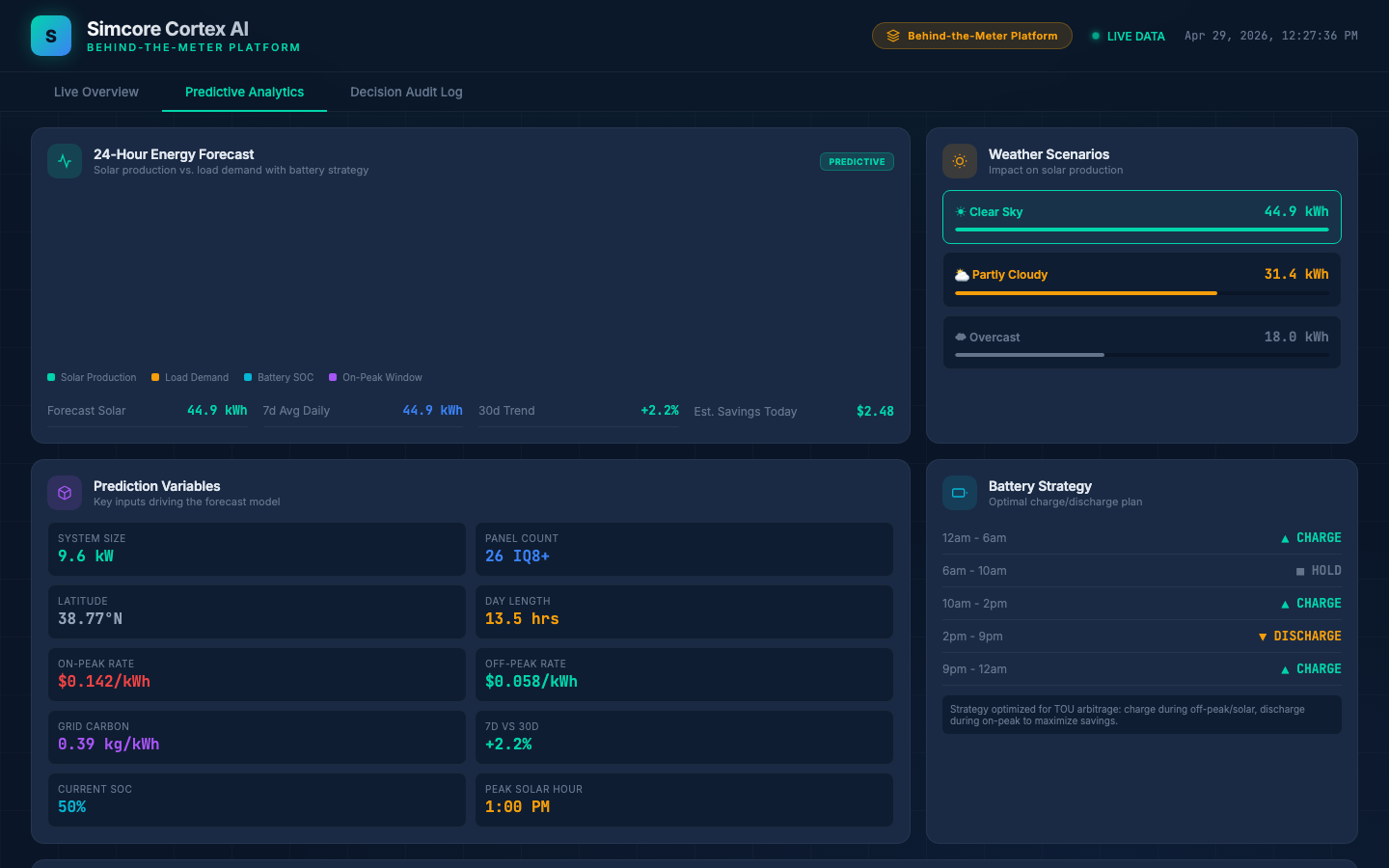
Simcore Cortex AI is an AI-powered platform that coordinates solar, battery storage, EV chargers, HVAC, and building loads into a single, optimized energy system for commercial and industrial facilities — regardless of equipment manufacturer.
Solar in one platform, battery in another, EV chargers in a third, BMS in a fourth. Each system optimizes for itself; none optimizes for the building.
Existing energy management platforms are proprietary to a single manufacturer. Buy one brand's battery and you're locked into their ecosystem forever.
Without coordination, batteries discharge on schedules while EV chargers pull from the grid at peak rates. NREL estimates coordinated dispatch saves 20–40% vs. uncoordinated.
Existing controllers use if/then rules that can't adapt to weather changes, unexpected loads, or dynamic utility pricing. Intelligence requires AI, not rule tables.
C&I solar deployments surging. Commercial battery storage attach rates climbing. EV fleet charging expanding. BTM devices are proliferating across commercial buildings — but coordination isn't.
Coordinated BTM resources can support grid stability through demand response — but only if they communicate. Today's siloed devices can't participate.
Communicates via IEEE 2030.5, SunSpec Modbus, OCPP, MQTT, CTA-2045, and manufacturer cloud APIs (Enphase, EcoFlow, Tesla, ChargePoint, Ecobee, Shelly). Normalizes production, consumption, storage, and controllable loads into a common data model. Add a new device by adding a connector — no platform changes needed.
The core intelligence. Ingests real-time device telemetry, utility rate schedules, weather forecasts, battery state-of-charge, EV departure requirements, and occupant preferences. Generates optimized dispatch decisions every 5 minutes. Built on Simcore's production multi-agent AI framework — proven in 12+ months of autonomous operation.
One dashboard replacing multiple vendor platforms. Shows current energy flows, projected savings, device status, demand charge tracking, and load management controls. The facility manager sees one system; the AI handles the complexity.
DOE/NIST-endorsed national standard for grid-to-DER communication. Required by California Rule 21 for smart inverters. The foundation for grid-interactive distributed energy.
DOE PriorityUtility-to-building demand response signaling. The bridge between BTM resources and grid operator dispatch — enabling coordinated load shifting and price-responsive behavior.
Grid-InteractiveThe foundational standard for connecting distributed energy resources to the electric grid. Updated in 2018 to require smart inverter functions including voltage and frequency ride-through.
FoundationalThe universal open standard for EV charger communication. Enables vendor-agnostic control of charging sessions, power levels, and scheduling across any OCPP-compliant charger.
EV IntegrationIndustry-standard protocol for solar inverter communication built on Modbus TCP. Supported by Enphase, SolarEdge, SMA, Fronius, and virtually every commercial inverter manufacturer.
Solar IntegrationDOE-backed standard for communicating with energy-using products — water heaters, HVAC, pool pumps, and other controllable loads. Enables load flexibility without replacing existing appliances.
DOE PriorityMQTT for lightweight edge-to-cloud messaging across IoT devices. Matter for emerging device interoperability. Both enable real-time telemetry from submeters, sensors, and building controls.
Smart HomeStandardized access to utility usage data, enabling Cortex AI to ingest historical consumption patterns and real-time meter readings for optimization without utility-specific integrations.
Consumer DataDirect API connectors for Enphase, EcoFlow, Tesla, ChargePoint, Ecobee, and Shelly — providing immediate device compatibility while standards-based protocols mature across the ecosystem.
Immediate CompatibilityOptimize for their own devices, lock building operators into one ecosystem
Static time-of-use schedules that can't adapt to real conditions
All decisions routed through remote servers with latency and outage risk
Software teams building for hardware they've never installed or maintained
Connects any device with an API. Building owner picks the best hardware, we coordinate it
Multi-agent AI learns building load patterns, adapts to weather and dynamic pricing
On-site AI for safety-critical dispatch. Cloud for analytics. Secure by design
We design, permit, and install solar+storage. Then optimize it with Cortex AI
Commercial-scale ground-mount solar installation. Designed, permitted, and constructed by Simcore Energy with Pepco grid interconnection.
Active installation with solar, battery storage, and EV charging. Real-world testing environment for the Cortex AI optimization engine at building scale.
Former U.S. Department of Energy, Morgan Stanley, GE Ventures, Head of US Low Carbon at Bechtel. Harvard Kennedy School MPA, Wharton MBA. NABCEP PV Associate. Licensed solar contractor.
Licensed Professional Engineer & Master Electrician. 10+ years at LA Department of Water and Power. Developer of the Cortex AI platform. Wharton MBA, BS Civil Engineering.
C&I deployment specialist. ~$2B prior real estate transaction experience. Wharton MBA, dual BS EECS & Finance from MIT.
University research partnerships for energy optimization modeling and interoperability standards validation.
Commercial & industrial solar site origination partners providing a growing pipeline of C&I deployment sites for Cortex AI.
Community solar and distributed energy program partners enabling access to multi-tenant and commercial deployments.
Active integration with leading solar, battery, EV charger, and building automation manufacturers across multiple protocols.